


All About Culture
Centered on Tri Hita Karana, Balinese culture is intertwined with harmony between God, People and Nature.


Bargaining Culture
Does this contribute to sustainable job opportunities?
Being a shopaholic myself, I took advantage of the currency rates that were considerably cheaper as compared to Singapore's. While I was doing shopping on our free day at the Ubud market, my intentions changed when it comes to spending habits. It was no longer about adding new pieces into my wardrobe. However, I was beginning to spend money to support the locals who were depending on tourists to purchase their products for their livelihoods. The locals convinced us to make a purchase even for something of a small value as they were not making much sales either.
I noticed that Ubud's Art Markets are dispersed all over Ubud Central, with many of its products being repetitive. Every store we passed within the stretch of street sells the same type of items namely rattan bags, bracelets, batik apparels and huge dream catchers. Each store lined the streets with a pop of colour where it's abundance makes you beam in awe. In reality however, these products are all similar. Perhaps, one of the marketing strategies was to group these items together in plenty amounts to psychologically appeal to tourists, further inducing tourists' consumption. This is especially so when the purchasing power is derived from tourists and less of that from the locals who have possibly owned these items already.
With increased competition from neighbouring stores, I couldn't help but wonder how these shop owners earn their profits due to the lack of unique selling points. With the bargaining culture that remains prevalent in these traditional shops, shops owners are earning lesser than expected. Additionally, being in the heart of Ubud with heavy tourist traffic poses higher rent expenses.
Bargaining or just accepting any payment?
Upon arrival at the Ubud Art Market, I wanted to buy a batik cardigan which costed 50,000 rupiah. However, I only had 15,000 rupiah in cash. Despite that, the shop owner still took whatever that is left in my wallet without negotiation. Another group of my friends then tried out the same strategy and received the same reaction. The difference was alot in comparison to what we are allowed to bargain in Singapore. With mostly fixed prices even in traditional shops, the bargaining culture is diminished in Singapore.
What needs to be done
This incident leaves me pondering about how Bali can improve its job security in the post pandemic era. Being stuck in tourist-reliant jobs is an uncertain situation not only with the day to day profits but also the fear of another pandemic happening again in the future. As such, more needs to be done to create sustainable jobs of the future, where the locals feel safer about their jobs instead of being stuck in a fragile situation.



Spirit of Togetherness
Centered on Religion & Deeply-Rooted Cultures
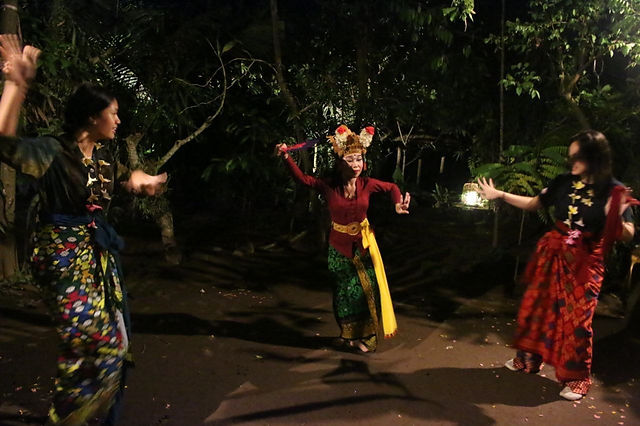
What I noticed upon entrance of the villages and Banjars is being greeted by a cultural attire comprising that of a sarong, kebaya and a frangipani flower wreath during the cultural night and throughout the day spent at Penglipuran Tourism Village. Balinese culture is one that is prominently deep-rooted in their way of lives.
The Singaporean Context
As Singapore embraced its modernity and cosmopolitan social structures, we are losing sight of our authentic cultural belongingness. For instance, being a Malay Singaporean myself, I started to experience a shift of preferences of the traditional baju kurung and almost always preferred a touch of modernity in my Hari Raya outfits. While Hari Raya is a month-long occasion, I no longer stick to the specific time frame, only going for house-visits as and when I am available. Singapore's prevalence of hustle culture and fast-paced lifestyle has developed a work-driven ecosystem with materialistic gains.
"Gotong-royong", in other words, "Spirit of Togetherness", is also prevalent in Bali where villagers would help each other out in preparing food. This can be seen during our cooking session at Pejeng Village, where the chefs conducted a cooking workshop where we were involved in the little bits and pieces of the dishes.
At the cultural night on the other hand, children performed the Traditional Balinese Dance in which they are part of an interest group within the village. In the Singaporean context, this represents a Co-Curricular Activity (CCA), which I thought was an amazing platform for cultural preservation amongst the younger generation especially if they could make a career out of it.
Singapore on the other hand, has a less thriving Arts Industry as cultures have been diluted to fit the modern narrative. In our institutional grounds, cultural CCAs such as Malay Dance and Chinese Orchestra remain, however these cultures have a richer depth to it, with more varied dances and forms of art.
Authentic Cultural Preservation - Bali for Tourism or Tourism for Bali?
One thing that I thought about is the authenticity of cultural preservation, whether it is preserved for future generations to follow or solely for the sake of Bali for Tourism. While it was a wonderful sight to see staff dressed in traditional costumes within the Penglipuran Village compound, I questioned the authenticity of such practices. Part of it feels rigid, more of a staged act, even the small shop houses that lined the village.
Only one area felt more natural to me, which was the Bamboo Forest. Walking into the Bamboo Forest felt relieving, almost as if stepping away from rigidity and the immense crowds that were surrounding the photo opportunity areas.
We ended off the day eating an onde-onde like kueh which was purple in colour and filled with gooey gula melaka. Instead of pandan as a star ingredient, the locals used purple taro. After which, I learnt from Agung, our tour guide, that Indonesia's version of onde-onde is one which is filled with mung bean instead of the typical palm sugar!
.jpeg)

An Agriculture-Centric Culture
Nature plays an integral role in Balinese daily life
Being warmly welcomed and greeted by flower wreaths and coconut drinks is a profound memory that I will never forget. Based on the Tri Hita Karana, Balinese culture revolves around harmony with nature. This is apparent in all of the little things such as gestures which included little bits of nature within them.
Coconut, coconut and more coconut!
At the Pejeng Village, we were greeted with huge coconut drinks the size of our faces! According to our tour guide Danis, who has a medical background, he mentioned that coconut water has the same mass as our blood, which explains why it is an effective natural remedy for illnesses such as cough and fever. The coconuts of different colours also serve various functionalities. For instance, the yellow coconut is good for pregnancy, the orange provides purification for the body while the green clears toxins and is especially effective during hangovers.
Significance of Alang-Alang Leaves
During our Pejeng Village tour, Pak Kadek, head of Banjar, explained to us about the nature-centric culture that still exists to this very day. Back in the past, villagers huts would be made out of coconut leaves while the royals or the riches of them would use alang-alang as a roof for their houses.
In religious ceremonies, the alang-alang is also used to "renjis air" or splash holy water on individuals undergoing purification processes. Additionally, rice grains will also be positioned on their forehead in which rice represents kindness and goodness. For men who are getting married, they would then eat the rice grains to consume all of the good fortune in building their families.
Aside from the alang-alang leaves being part of Balinese history, architecture and rituals, it can also be used in games. In this game, the alang-alang leaf is being parted into three parts, with the middle being the "bullet". At the count of three, everyone in the game will have to shoot the "bullet" by pulling down the two sides of the leaf. The one who shoots the furthest will win the game!
Nature, a Formidable Force
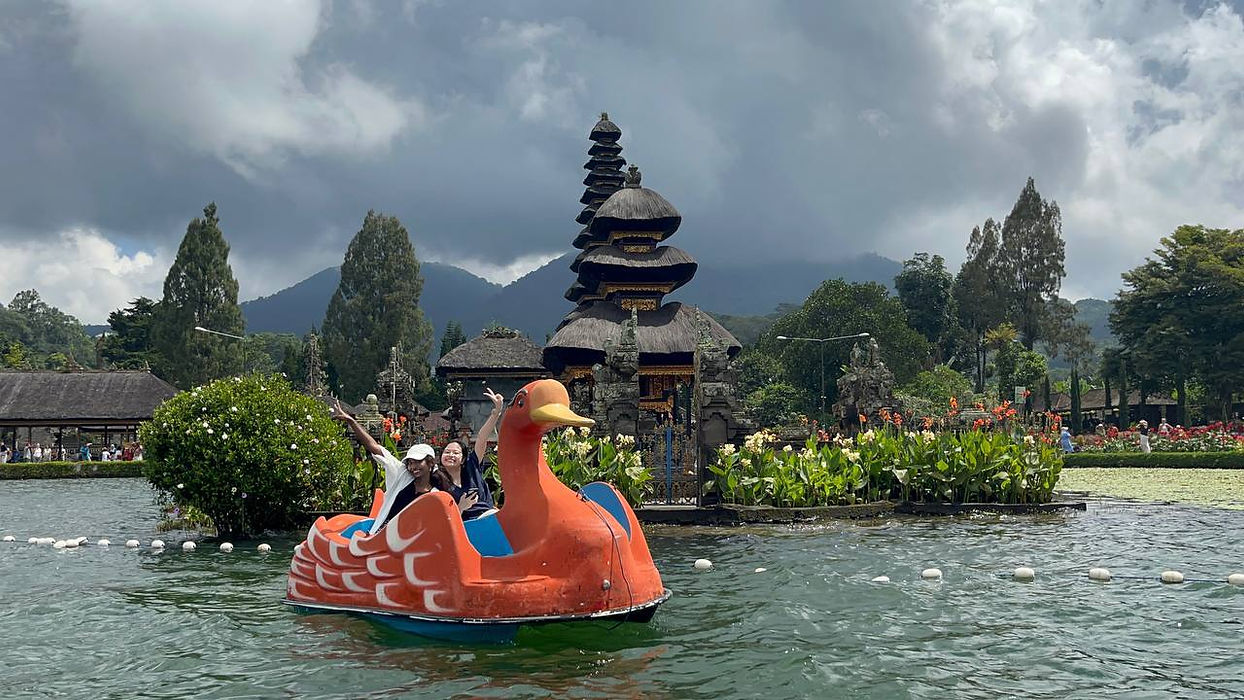
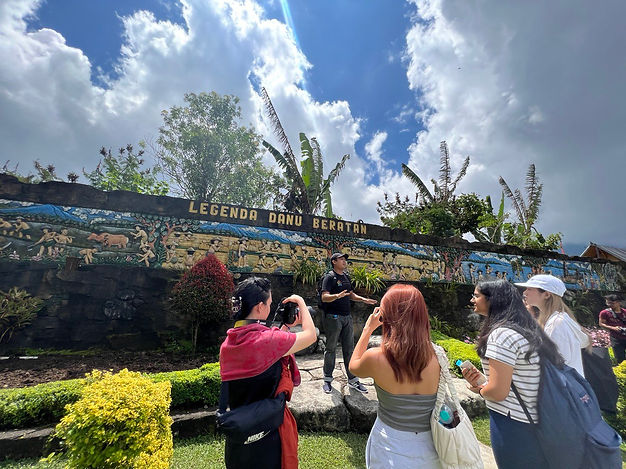
At the Ulun Danu Temple, we dived into a little history on "Legenda Danu Beratan" where our tour guide, Agung, explained how the Ulun Danu Temple is surrounded by a huge water body. In the past where drought was a huge misfortune towards farmers and their crops, they got angry and stomped the land demanding for water as sustenance for these crops. Agitated and frustrated, it was a collective resentment towards God for the lack of provision. Surely enough, a water body near the temple magically appeared and to this day, it is now the Ulun Danu Temple!